
MIBE are updating the Building Compliance Documents relating to the New Zealand Building Code
Click here to find the compliance requirements for fire codes for floor covering and wall coveringsPage 77
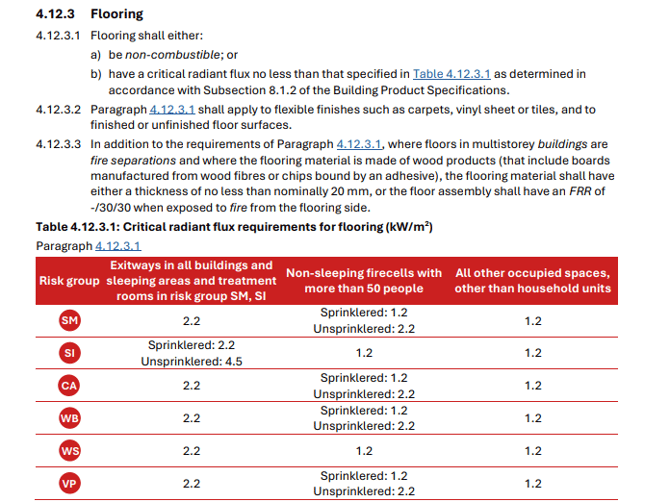
*when tested to ISO 9239:1 2010

The New Zealand Building Code (NZBC) C/AS1 document primarily provides an Acceptable Solution, which includes references to specific, established standard fire test methods in its Appendix C.
If a proposed building design or product deviates from these specified methods, it is considered an "Alternative Solution".
Standard Test Methods referenced in C/AS1
C/AS1 generally refers to a list of standard test methods in its Appendix C, which include internationally recognised standards. Examples of standards cited or correlated to the NZBC include:
- For surface finishes:
- ISO 9705 (Room fire test).
- ISO 5660 (Cone calorimeter test), which can be correlated to ISO 9705 for material group numbers.
- EN 13501 (Fire classification of construction products), which provides a classification system (Class A to F) that can also be correlated to the NZBC group numbers.
- For fire resistance ratings (FRR) of elements (e.g., walls, floors):
- The "standard test for fire resistance" is generally understood to be relevant national or international standards that determine a product's structural adequacy, integrity, and insulation performance over a period of time (e.g., 30/30/30).
"Alternative" Fire Test Methods (Alternative Solutions)
Any test method or design approach that is not explicitly listed as a standard in C/AS1's Appendix C (or other referenced standard) is classified as an Alternative Solution.
Developing an Alternative Solution involves a performance-based design approach, which requires a formal process:
- Engage a Fire Engineer: A qualified fire engineer is typically required to develop and verify the proposed alternative design.
- Performance-Based Design: The design must still demonstrate compliance with the performance requirements of the NZBC Clauses C1-C6 (Protection from Fire), rather than the prescriptive methods in the Acceptable Solution.
- Fire Engineering Brief (FEB): A critical step is discussing the proposed analysis methods and design acceptance criteria with key stakeholders, including the local Council (Building Consent Authority), through a Fire Engineering Brief process.
- This ensures agreement in principle before formal submission.
-
Verification: The alternative method will often use specific calculation methods, fire modelling, or different experimental data from non-standard tests, all of which must be rigorously verified and documented.
Ultimately, while C/AS1 specifies certain tests, the NZBC framework allows for flexibility through Alternative Solutions, provided the building owner and designer can prove the design meets the required level of safety.
Fire Test Standards are now located under Building Product Specifications
Page 30
For the full details on group numbers, correlations and alternative substrate testing refer to Page 30